Suppose your firm finishes a month with £120,000 of billable work, £105,000 of billed work and £90,000 in collected professional fees. At the next partners’ meeting, someone asks what happened to the missing £30,000.
There may not be £30,000 missing. The month’s time entries, invoices and payments need not relate to the same underlying work. Some receipts may settle older invoices; some newly recorded work may not yet be due for billing. Before deciding what to change, the firm needs to establish whether the difference reflects timing, a billing problem or a genuine reduction in recoverable fees.
A collection funnel puts those figures alongside one another. Its value lies in helping you ask a more specific question than “Why are collections low?” Reading it properly starts with understanding what each stage measures—and what the spaces between them cannot tell you on their own.
Collection performance has two dimensions
How much gets paid and how long money remains tied up are separate questions. A firm can ultimately collect an invoice in full and still have to fund its work while it waits. Legal-sector accountants Armstrong Watson describe lock-up as the combination of unbilled work in progress and unpaid debtors, and explain how slow conversion into cash can strain an otherwise profitable practice.[1]
Clio’s 2025 benchmarks illustrate the distinction: they report an average collection rate of 93% and median total lock-up of 93 days. The first concerns the proportion of invoiced work that gets paid. The second expresses the value of unbilled work and unpaid invoices as an equivalent number of days of revenue; it does not mean that the typical individual invoice takes 93 days to settle.[2]
Those figures come from Clio’s U.S. research population. They provide context, rather than a universal target or a benchmark for UK firms. The report’s methodology identifies its platform dataset as aggregated, anonymised information from paid U.S. subscribers.[3]
Four stages, four different questions
The Collected widget in dashboardWISE brings together Target, Billable, Billed and Collected in a horizontal funnel chart. It compares the selected people’s billable-work target with work recorded, time billed and fee cash received for the reporting period.
Returning to the example, suppose the firm’s billable-value target was £150,000:
These figures are illustrative, not customer results.
The percentages all use the same denominator: the target. A Collected figure of 60% therefore means that fee receipts equal 60% of the billable-value target. It does not mean the firm collected only 60% of its invoices.
Clio defines collection rate as the proportion of invoiced work that gets paid.[3] Measuring progress against a work target answers a different question. You cannot compare the widget’s 60% directly with the 93% collection benchmark and conclude that the firm is underperforming by 33 percentage points.
The target itself also needs context. In this widget, the monetary target is derived from the billable-hours target and the applicable rate, with target adjustments reflected where relevant. It is a reference point for the comparison, not a separate cash forecast predicting that all work performed this month will be paid this month.
Check the dates before calling a gap a loss
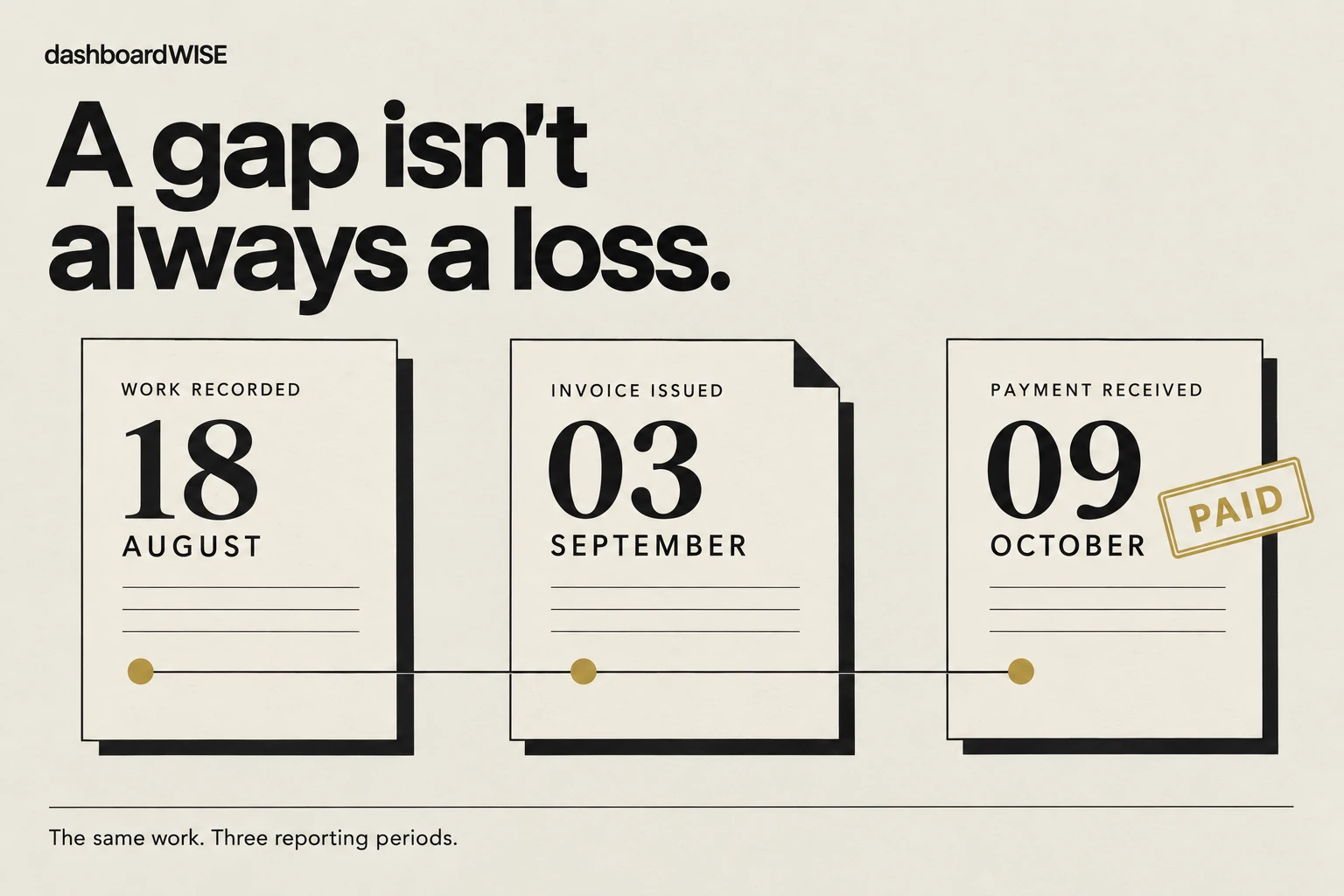
Consider a piece of work completed on 18 August, invoiced on 3 September and paid on 9 October. Under the widget’s date rules, its billable work belongs in August, its billed time in September and its collection in October.
The work has moved successfully through all three stages, but no single monthly view contains the entire journey. Clio’s own revenue-report documentation makes the same important distinction between bill issue dates and payment dates when determining which figures appear in a selected period.[4]
This explains why a collection funnel need not narrow continuously. October’s receipts could exceed October’s billing because clients are paying September’s invoices. Likewise, a month of substantial new work may show relatively little collection because the corresponding invoices have not yet been issued or become due.
Neither shape establishes success or failure by itself. It identifies a question to investigate.
To find out what proportion of September’s invoiced value has been paid, follow those invoices and their linked cash payments, on the same value basis, through a stated cut-off date. That is an invoice-cohort analysis: it follows the same group of invoices. A period view of September billing beside September receipts includes different populations and cannot answer that question merely by dividing one total by the other.
The same reasoning applies to balances. This month’s billing minus this month’s receipts is not, by itself, the firm’s outstanding receivables. It omits opening balances and may mix receipts from earlier invoices with current billing. Nor does billable work minus billed work establish the current WIP balance. For those questions, use the actual unbilled-work and outstanding-invoice records. Clio’s billing documentation distinguishes these balances and separately records payments, credit notes and amounts still due.[5]
Be precise about what has been collected
For this widget, Collected means professional-fee cash attributed to the people whose billed work generated it. Expenses, tax, interest and other non-fee amounts are excluded. The result is narrower than the firm’s total receipts, and it is not a measure of profit.
That distinction matters when an invoice is only partly paid. Take a simplified invoice containing £1,000 in professional fees and £200 in expenses, with no tax or other charges. The client pays £600.
Under the widget’s proportional allocation method, £500 of that payment is attributed to fees and £100 to expenses. If two people contributed 60% and 40% of the billed fee value, their Collection amounts are £300 and £200 respectively. Excluding expenses from the displayed metric does not mean ignoring them when deciding how much of a mixed payment represents fees.
This is a reporting method that needs to be understood when comparing systems. Clio’s documentation, for example, explains that its reports allocate partial payments proportionally by default, but that changing the allocation setting can change the reported components.[4]
Refunds and credit notes also require care. Supported, dated refunds reduce this widget’s Collection on the refund date. A credit note is not a cash receipt: reducing an invoice balance is different from receiving payment. Clio’s reports also distinguish credits from collected amounts.[4]
What the hours and individual views mean
Switching the widget to Hours changes the unit, not the timing principle. Collected hours are paid-equivalent billed hours: the share of a person’s billed hours represented by the fee cash allocated to them.
For example, where an invoice contains ten billed hours for one person and half of that person’s final fee entitlement has been paid, the equivalent is five collected hours. Those are not five hours newly worked in the payment month. The calculation relates the payment to the hours and fee entitlement on that invoice, rather than dividing cash by someone’s current hourly rate.
The person filter needs equally careful interpretation. It lets you examine all permitted people in the current dashboard scope or one individual. Collection is attributed to ownership of the billed work; it does not identify who sent a reminder or persuaded the client to pay.
Before using that view to judge performance, establish who controls billing approval, which payment terms apply and where responsibility for follow-up sits. A fee earner’s current-month work and the cash arriving against their earlier work describe different aspects of performance. ILFM’s discussion of billing and lock-up stresses that responsibility extends beyond the finance department to fee earners and management.[6]
There is also a difference between zero and unavailable. When a selected person’s required data is incomplete, the widget keeps the affected aggregate unavailable rather than silently excluding that person and presenting a partial sum as the total. An “N/A” needs a data-quality check before a performance conversation.
Use the funnel to decide what to investigate
The next step should depend on the question the comparison raises.
When billable work is below target, check the period, target adjustments and completeness of time recording before concluding that the firm needs more work. A month still in progress deserves a different reading from a completed month. So does an individual whose working pattern or approved target has changed.
Where billable work is strong but billing is lower, inspect the unbilled work. Is an invoice waiting for approval? Has a billing milestone not yet been reached? Is there a scope or fee discussion that needs resolving? Those situations call for different responses. ILFM identifies unclear billing triggers and partner accountability as contributors to WIP accumulation, including in busy practices.[6]
Where billing is strong but receipts are lower, examine outstanding invoices and their due dates. Distinguish an invoice still within agreed payment terms from an overdue invoice or an unresolved dispute. An ageing report helps make that distinction; Clio’s aged-receivables report, for example, separates current amounts from overdue balances measured against the bill’s due date.[5]
High collections deserve examination too. Receipts from older invoices may explain a strong month even while current work or billing has weakened. In that case, the useful follow-up is to establish how much of the result came from clearing earlier balances and what is likely to support subsequent collections.
The widget’s Details link opens People Performance with the reporting dates and selected scope preserved. From there, the review should progress to the relevant work, invoices or payment records, rather than stop at an aggregate or a ranking.
For the next partners’ meeting, take the largest unexplained difference and trace a small sample of the underlying records. Establish what remains unbilled, what is genuinely overdue and what simply belongs to another period. Give each unresolved item a named owner, a next action and a review date.
That is a useful outcome from a collection funnel: a specific explanation for the figures and a decision about what happens next.
References and further reading
- Armstrong Watson, “Lock-up reviews”. Definition of lock-up and its effect on liquidity. Accessed 10 October 2026.
- Clio, “Law Firm KPIs: Key Performance Indicators & Benchmarks”, 2025 benchmarks. Average collection rate, median total lock-up and lock-up calculations. Accessed 10 October 2026.
- Clio, 2025 Legal Trends Report, Appendices A and B. KPI definitions and research methodology. Accessed 10 October 2026.
- Clio, “Clio Manage Revenue Reports”, updated 1 October 2026. Reporting dates and partial-payment allocation settings. Accessed 10 October 2026.
- Clio, “Clio Manage Billing Reports”. Receivables, WIP, due-date ageing, payments and credit notes. Accessed 10 October 2026.
- Robert Banner, Institute of Legal Finance and Management, “Managing lock-up, cash flow and billing inefficiencies better”. Billing triggers, accountability and the roles of management, fee earners and finance teams. Accessed 10 October 2026.